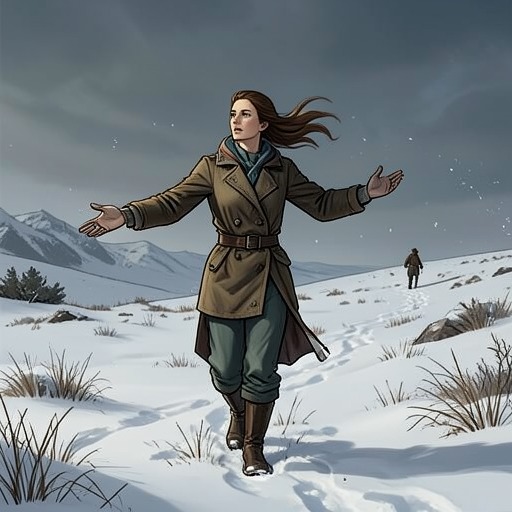
Schuckert Valley
Smilla's Sense of SnowSchuckert Valley, in Northeast Greenland, is an Arctic desert that holds a pivotal place in Smilla’s memories of Greenland. Its heat, dry terrain, and brief summer light make it a landscape of extremes; for Smilla, however, it is also the setting of a long journey with Moritz that briefly bridges years of separation and becomes an irrecoverable memory of closeness.
Landscape and climate
The valley lies across a plain of flat, lifeless steppes, sand dunes, and salt pans. During the short summer, the polar sun heats the cliffs to 95°F, while dried riverbeds and rocky ground shimmer with heat. The expedition took two days to cross this mosquito-plagued terrain. These details make the valley neither an empty backdrop nor a simple wilderness: its conditions govern how people travel, endure, and find water.
A sandstorm interrupts the journey. With their water exhausted, the travelers lie flat beneath scarves until the storm eases. A young participant becomes delirious from thirst. For Smilla, the scene is inseparable from the valley’s midnight sun: blowing sand briefly forms a bright curtain around it, an image held alongside the danger and exhaustion of the crossing.
Journey and memory
Smilla recalls feeling clear-headed and happy in the valley for no explicable reason. Her brother was there as a hunter, and it was the last time the two took a long journey together. The expedition temporarily displaced the history that divided them: she remembers feeling like a child again, as though the twelve years of separation following Moritz’s decision to take her to Denmark had not happened.
The recollection returns when Smilla, homeless, seeks the familiar feeling of a place where she once felt settled. The hot air of a clothes dryer reminds her of desert air, and the memory leads back to Schuckert Valley. Its sweetness is not a promise of reunion: Smilla understands that death leaves the living alone with memories they can no longer share. The valley therefore persists as a refuge in recollection and as a reminder of what cannot be recovered.
Greenlandic knowledge and spatial freedom
Elsewhere, Smilla describes Greenlandic life through practical knowledge and relationships to land rather than through abstract cultural rankings. Her mother hunts and paddles a kayak as well as carrying out work associated with women; when her grandfather’s failing eyesight threatens the family’s survival, she shoots a seal herself. Smilla also remembers hunting birds after a day without food, then releasing her catch when she sees their young as part of a chain of vulnerable lives. Such scenes make subsistence, kinship, and attention to animals concrete parts of the world from which her sense of place develops.
Smilla argues that understanding another culture requires living within it as a tolerated guest and learning its language; explanation alone can create distance. Her childhood memories are of a life rarely spent indoors and of a mother for whom remaining in one place was unthinkable. That history helps explain why she experiences spatial freedom as something precious and why a locked room can represent a specifically oppressive form of confinement. Schuckert Valley’s open, arduous expanse stands in sharp contrast to the closed spaces through which authority attempts to contain her.